
Carroll County Dissolution Of Marriage
Carroll County Dissolution Of Marriage records are a mix of old court files, state divorce certificates, and archive indexes that help you trace a case from filing to final decree. Start with the county history held in the Ancestry collection, then move to Tennessee Vital Records for newer certificates and the Tennessee State Library and Archives for older files. If you are trying to confirm a name, a date, or a case number, Carroll County gives you more than one path. The best search often begins with the county file, then checks the state trail that follows it.
Carroll County Quick Facts
Where Carroll County Dissolution Of Marriage Records Start
The strongest Carroll County starting point is the local Carroll County Ancestry Database. It includes Tennessee divorce and court records from 1800 through 1965, and it specifically lists Carroll County Divorce Court Files from 1826 to 1900 plus Carroll County Divorce Court Indexes from the same span. That matters because the names are transcribed, the images can be browsed, and the data often shows the date and case number that tie one person to one court file. For many family history searches, that is enough to prove where a case lived on paper.
The county source does not replace the court. It points you to it. When a record is still current or you need a certified copy, the usual next stop is the Circuit Court Clerk or Tennessee Vital Records. Older material moves toward the state archive system after the 50-year mark, so a full search often starts local and then expands to state records. That pattern saves time, and it keeps you from guessing which office still holds the paper trail.
The local collection is useful even when the file is incomplete. Some entries show only a name and a date. Others give a clearer path to the original paper file. Carroll County researchers should treat the database as a map, not the whole trip.
Carroll County divorce history is scattered across time, so a clean search uses more than one source. The county index can point to the archive copy, and the archive copy can point to the certificate or decree you still need. That is the difference between a quick lookup and a complete record search.
Look first for the name, then the year, then the court note. Those three pieces often tell you where the rest of the file is hiding.
When a name is transcribed, the browse table may show the scan tied to the record. That is useful when a case file is old or the clerk office needs more detail before it can pull a copy.
Lead source: The Carroll County Ancestry Database is the best local tool for older Carroll County Dissolution Of Marriage research.
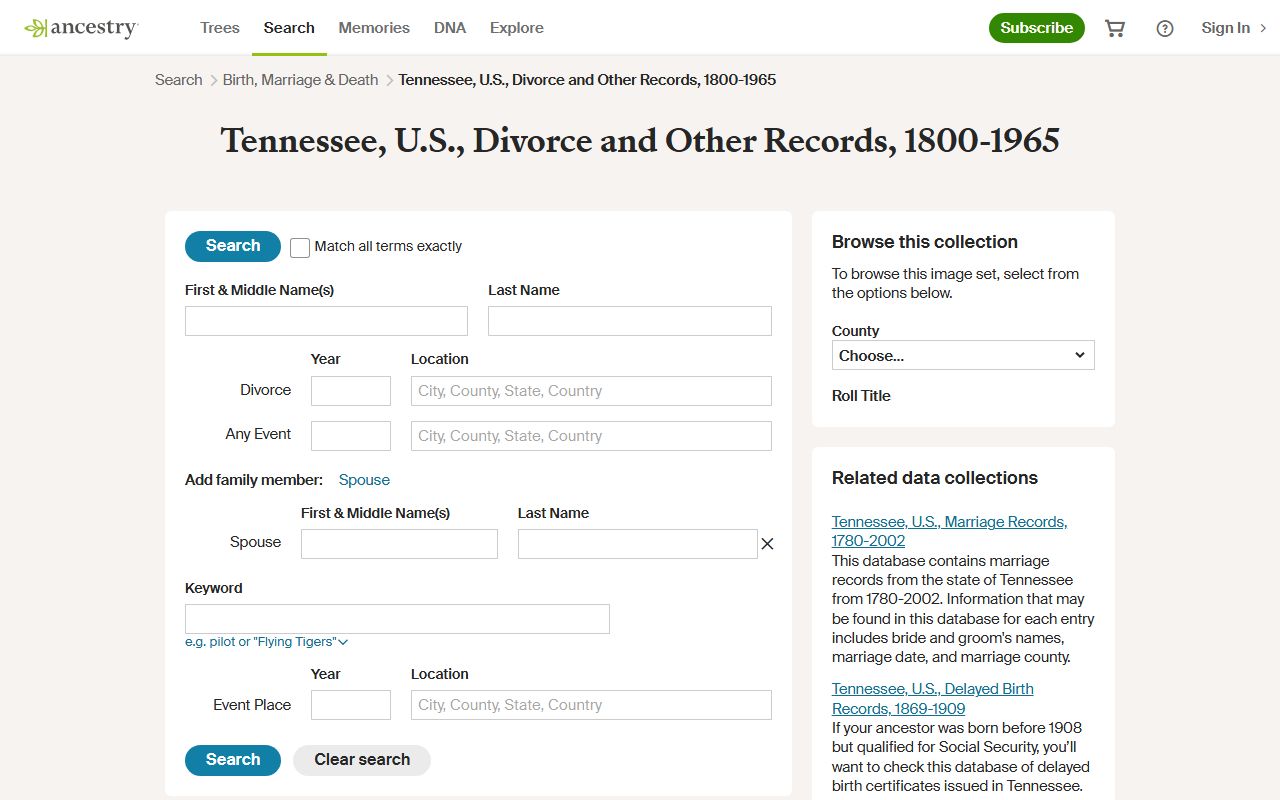
Use it for names, dates, and case numbers, then move to county or state records for a certified copy or a fuller file.
How to Search Carroll County Dissolution Of Marriage Records
Searches work best when you keep the facts tight. Use the full name of at least one spouse. Add the approximate year if you know it. Then match the county with the court or archive source that fits the time period. Carroll County is a good example of why that order matters. The county collection gives you indexed names, while Tennessee Vital Records and TSLA cover the later archive trail.
For newer records, Tennessee Vital Records is the state office that issues divorce certificates. The office keeps divorce records for 50 years, then older files move to the Tennessee State Library and Archives. The CDC's Tennessee guide at cdc.gov repeats that same rule and confirms the state payee name. If you need to request a certificate, the state also says you must send a photocopy of a government ID with your signature. That rule helps keep the process tied to the right person and the right record.
You can also search through the public court system. The Tennessee courts site at tncourts.gov is the place to check for court access and forms. If a Carroll County record is still in active court files, that route can be faster than waiting on a mail search. It is also the cleanest way to confirm the county that handled the divorce.
The search list below is the short version of what helps most:
- Full name of one spouse
- Approximate filing year
- County name
- Any known case number
- Whether you need a certificate or a full decree
Once you have those details, you can move from the Ancestry index to the clerk office or the state archive without wasting time on blind searches.
Carroll County Dissolution Of Marriage Fees And Copies
If you need a certified copy, state fees matter. Under Tenn. Comp. R. & Regs. 1200-07-01-.13, the fee for a search and a certified or uncertified copy of a divorce record is $15.00 when the record is found. The same rule also says the search fee is still $15.00 even if no record is found. That is a useful detail for old Carroll County files, because a failed search can still carry the same cost as a hit.
The Tennessee Vital Records office in Nashville accepts in-person requests, mail requests, and online orders through the state vendor VitalChek. The office is located on the first floor of Andrew Johnson Tower at 710 James Robertson Parkway, and the main office uses regular weekday lobby hours. If you go in person, bring a valid ID with a signature and be ready to pay by cash, check, card, or money order, depending on how you submit the request.
For mailed requests, the state says the check or money order should be made payable to Tennessee Vital Records. That sounds small, but it keeps the request from getting delayed. It also matters when you are trying to get a replacement certificate for name changes, remarriage, or court use.
The county court file is different from the state certificate. The certificate confirms that a divorce happened. The court file shows the complaint, the response, the order, and often the settlement details. If you need the terms of the divorce, the certificate alone will not do the job.
Note: A failed search does not erase the fee, so it helps to verify the county, year, and record type before you send money or mail a request.
Carroll County Dissolution Of Marriage Files And Archives
Carroll County divorce history is strongest in the old court materials. The Ancestry collection points to Carroll County Divorce Court Files from 1826 to 1900 and Carroll County Divorce Court Indexes from 1826 to 1900. The original data comes from Tennessee county records at TSLA, and the microfilm roll numbers include the B-roll series. That gives the county page more depth than a simple index list. It gives you a path into the paper world that existed before modern filing systems.
Older divorce files often show the names of both parties, the date, and the case number. Those details may be enough for a family line, but they may not be enough for a legal request. When you need certified proof, the clerk office or Tennessee Vital Records is still the better path. When you need history, the archive is the better path. Carroll County benefits from both.
The Tennessee State Library and Archives keeps divorce records older than 50 years. That is the key boundary for Tennessee. It is also why a county search should not stop at the courthouse window. A case can move from active court storage to state archive storage, and the searcher who knows that rule gets to the record faster.
The TSLA system is especially helpful when the local file is thin or the court note is only part of the story. Many early Tennessee divorce records were kept with other county court materials, so the file may sit beside related minutes, orders, or estate papers. That makes the archive valuable even when the divorce record itself is brief.
The other advantage is time. Historical records do not sit in one office forever. When a file reaches the archive, it often becomes easier to place in a family history search. That is why Carroll County researchers should think in layers: local index, local court, then TSLA.
Source note: The Tennessee Vital Records page and TSLA work together to explain where newer Carroll County Dissolution Of Marriage records end and older ones begin.
Tennessee Dissolution Of Marriage Forms And Waiting Periods
If a Carroll County case is still pending, the Tennessee court rules matter more than the archive trail. Tennessee courts offer approved forms for agreed divorces through the Tennessee Supreme Court divorce forms page. Those forms are for uncontested cases where the spouses can agree on the main issues. They include the request for divorce, the divorce agreement, a final order, and the notice of hearing.
The form packet is not for every couple. The court says the spouses need to meet the residence rule, have no minor children in the eligible category, and agree on property and support terms. That makes the packet useful for a clean filing, but not for a disputed one. If you are searching old Carroll County records, the form packet can still help you understand the paper trail a modern file would create.
The law behind the process is in T.C.A. § 36-4-101, T.C.A. § 36-4-103, T.C.A. § 36-4-104, and T.C.A. § 36-4-121. Those sections cover the grounds for divorce, the irreconcilable differences process, the residence rule, and the way marital property is divided. Tennessee also uses a waiting period of 60 days when there are no minor children and 90 days when there are minor children.
That waiting period matters because it shapes the file. A quick agreement still leaves a paper trail. A contested case leaves even more. When you search Carroll County Dissolution Of Marriage records, those case papers can explain why the final order looks the way it does.
Some families only need to know whether the divorce was final. Others need the terms. The approved forms page helps with both because it shows the structure of a modern Tennessee case without forcing you to guess at the clerk's filing stack.
Note: If the case involved children, agreements, or property, the court file will often tell you more than the certificate ever will.
Common forms in the agreed-divorce packet include the request for divorce, the divorce agreement, and the final order. That short set is enough to show how Tennessee handles a clean filing from start to finish.
Public Access To Carroll County Dissolution Of Marriage Records
The Tennessee Public Records Act, explained by the Office of Open Records Counsel at comptroller.tn.gov, says citizens may inspect and receive copies of public records. Divorce records in court custody usually fit that public-record rule, though parts of a file can still be redacted for minors, financial data, or sealed documents. That means a searcher often has access, but not to every line in every page.
The act also gives the records custodian seven business days to respond when a record cannot be made available right away. The response can be a release, a written denial, or a written time estimate. If you are waiting on an old Carroll County file, that time rule gives you a way to tell whether the office is still working on the request.
Copy costs can apply if you ask for paper records. The state guidance lists 15 cents for black and white copies, 50 cents for color, and possible labor charges after the first hour. There is no charge to inspect records in person. That split matters when you want to decide between a quick visit and a mailed request.
Requests can be made in person, by telephone, fax, mail, or email when the office uses those methods. Some offices also take requests through an online portal. The format can change from one office to the next, so it pays to ask how Carroll County wants the request sent before you start.
Public access is broad, but not automatic. You still need the right office, the right record type, and enough detail for the clerk to find the file.
Help With Carroll County Dissolution Of Marriage Research
If you are piecing together a file, the best help is often a mix of state guidance and legal support. The Tennessee Bar Association domestic relations resource page at knoxbar.org explains the divorce grounds and notes that evidence in divorce cases is usually corroborated. That is useful when you are trying to understand why a record contains more than one witness statement or why a court file is larger than a simple decree.
For older Carroll County Dissolution Of Marriage records, the archive path can be as important as the court path. The state archive, the county index, and the state certificate office each serve a different purpose. If one office cannot help, the next one may still have the record. That is why a good search does not stop at one answer.
The Tennessee Courts site at tncourts.gov is the best place to check for current court forms, filing guidance, and general access notes. For a county like Carroll, where historical files and modern records live in different places, that court site helps bridge the gap between research and filing.
When you are ready to request a copy, keep the search details close. Name, year, county, and case number are still the fastest keys. If you are missing one of them, use the Ancestry index or the archive path first. Then move up to the clerk or state office for the certified record.
Carroll County research rewards patience. The trail is there, but it is split across old court files, state vital records, and archive storage. If you follow the order, the record usually turns up.